
The booking is digital, but the guest journey that follows is often fragmented.
A guest can book a room in 30 seconds. But what happens next? Collecting details, checking payments, arranging check-in, issuing keys and answering questions still happens across different systems and channels in many hotels.
Each component may work perfectly well on its own. The problem lies in the gaps between them. That is where duplicate work, waiting and uncertainty arise for both your guest and your hotel team.
Checkmate Assistant is not just another system in your hotel stack. It forms the connecting layer between your existing systems, your hotel team and your guest — from the moment the reservation arrives through departure.
The complete journey
6 connected moments- BookingThe reservation arrives and the personal journey begins.
- Pre-arrivalDetails, preferences and arrival arrangements are handled in advance.
- PaymentOutstanding amounts can be paid before arrival.
- Check-inYour guest completes the required steps independently.
- AccessThe correct key is released once everything is in order.
- Stay & departureService and assistance remain close at hand through departure.
One guest journey, using your existing systems
A hotel rightly uses several specialist systems. Your guest should not have to think about any of them. The PMS manages reservations, a payment provider processes payments, an access solution creates a physical or digital key, and housekeeping works with room statuses and tasks.
Checkmate Assistant forms the connecting layer between those systems, your hotel team and your guest. It retrieves the relevant reservation context, guides your guest through the required steps and makes connected systems work together at the right time.
That sounds simple. That is exactly the intention.
1. As soon as the reservation arrives
The journey starts with the booking, not at the front door.
Once a reservation is available in the connected PMS, Checkmate Assistant can prepare the appropriate guest journey. The arrival date, room type, booking status and your property's rules determine which steps are required.
Communication can begin by email or WhatsApp. The personal guest portal runs in the browser, so there is no need to download a separate app.
- Find and check the reservation
- Register missing details and accompanying guests
- Accept house rules or terms
- Pay an outstanding amount
- View arrival information and choose relevant extras
2. Pre-arrival without manual email exchanges
Pre-arrival is often where small exceptions take up a lot of reception time. Your guest may have the wrong link, an outstanding payment or an incomplete registration. When that information is scattered across inboxes and systems, every exception becomes a small investigation.
In Checkmate Assistant, your guest can see which steps remain. Your hotel team can follow the same progress. This makes it clear which arrivals are ready and which still need attention.
Automation here does not mean pushing every guest through exactly the same funnel. It means keeping the standard route consistent while making exceptions visible to a team member.
3. On a phone or at a self check-in kiosk
Your guest can complete the required steps on their own device. If you also want to offer self-service on site, the same journey can be made available through a kiosk.
Unlike a standalone kiosk form, the kiosk does not operate in isolation. Pre-arrival progress, reservation status and the steps taken on site all belong to the same guest journey.
- Recognise the reservation
- Check or complete guest details
- Complete registration and any required identity check
- Process an outstanding payment
- Release access once the conditions have been met
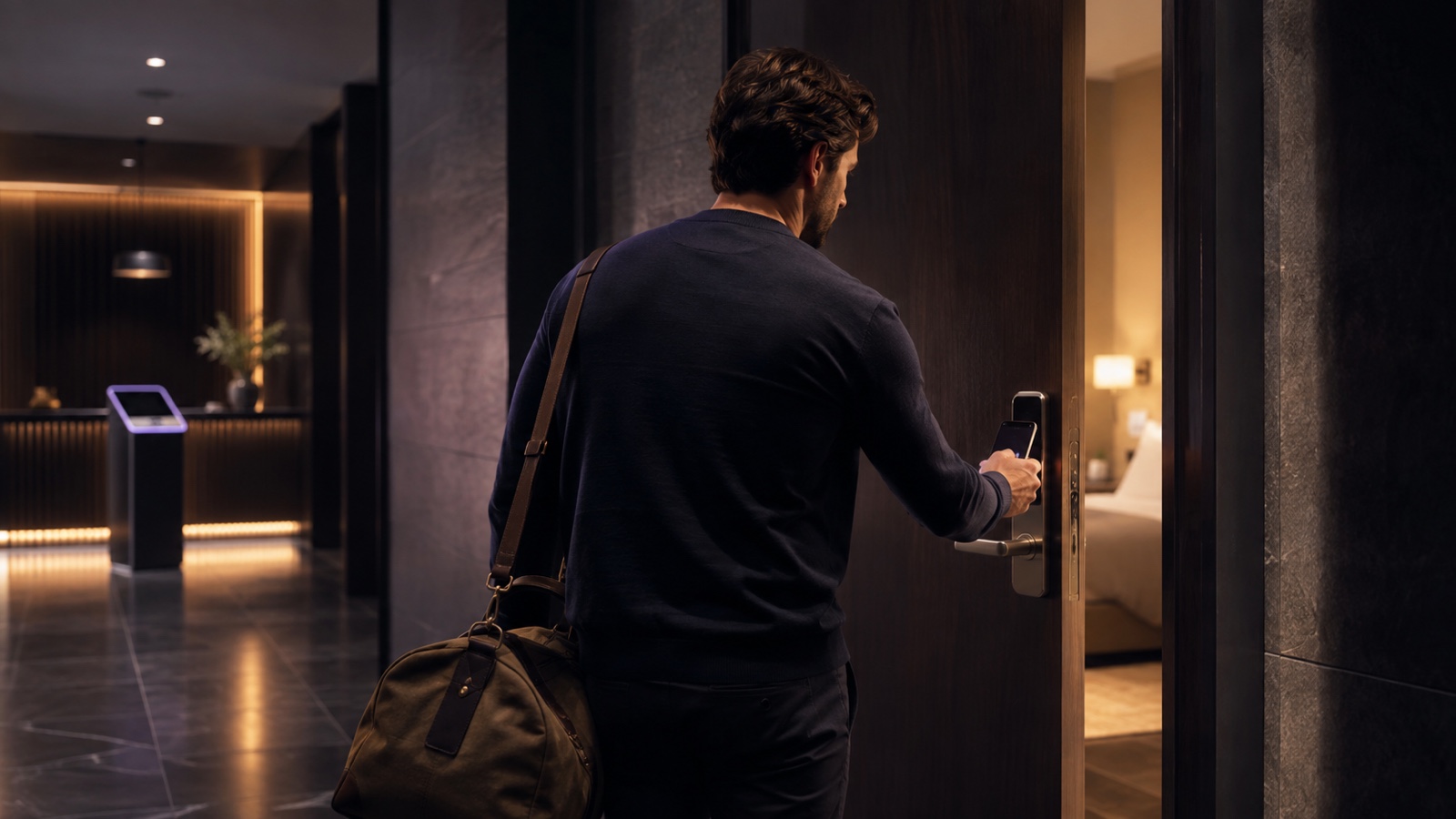
4. From successful check-in to the right door
The room door is a small part of the experience, but technically it is an important decision point. A key or digital access must only be issued after the correct reservation has been identified and the mandatory steps completed.
Checkmate Assistant can handle this handover through operational key-management and access integrations with Hotek Hospitality Group, Vingcard, part of ASSA ABLOY Group and Intratone, among others. Depending on the active system, the flow can provide a physical keycard, mobile key, access code or another digital access action. The available method depends on the selected hardware, hotel configuration and implementation.
For your guest, the result should feel effortless: finish check-in, receive access and walk to the room. Without an extra handover that exists only because two systems do not communicate.
5. Guest service before, during and after the stay
Many digital check-in solutions focus mainly on arrival. But questions and requests arise before, during and after the stay.
That is why Checkmate Assistant includes a Digital Hospitality Manager that can be available through several channels. It uses your property's information and working practices to help your guests with practical questions: check-in, breakfast, Wi-Fi, parking, housekeeping, room service, a taxi or local tips.
On the phone, your guest can have a natural conversation. When a question needs human attention, the call can be transferred to the appropriate team member. The aim is not to exclude people. It is to handle recurring questions promptly and keep your team available for situations where personal contact really adds value.
- Chat in the guest portal
- The hotel website
- A kiosk
- A voice assistant available by phone
6. One journey, visible to your hotel team
A connected guest journey only works when your hotel team can see what has been arranged, where a guest is stuck and which request still needs attention.
Connections to systems such as Mews and LodgeGate provide PMS context and synchronisation, alongside other adapters and custom integrations. The exact setup is determined for each property, because no two hotel technology environments are identical.
- Arrivals and outstanding check-in steps
- Communication across several channels
- Room status and housekeeping tasks
- Service and maintenance requests
- Follow-up by team members
- Reporting on usage, questions and workload
Where AI actually adds value
AI alone does not improve a guest journey. Value appears when an assistant has enough context, acts within clear boundaries and knows when a team member is needed.
Checkmate Assistant uses conversational AI to understand questions through chat and phone, formulate answers from hotel-specific information and, where possible, initiate the appropriate next step. The conversation is not a separate chatbot alongside operations. It is part of the same journey.
Control and handover remain essential. You determine which information, actions and escalation routes are available. Exceptions must be traceable and reach a person as soon as needed.
What does one connected journey deliver?
For your guest, it means less searching, less repeating themselves and more freedom to arrive at a convenient time.
For your hotel team, it means fewer manual handovers and a clearer view of what has already been arranged. Recurring questions and standard steps can be handled while staff focus on exceptions, personal service and the quality of the stay.
And for you as a hotelier, it creates one place to configure, follow and improve the journey, without pretending that all the underlying systems need to become the same.